
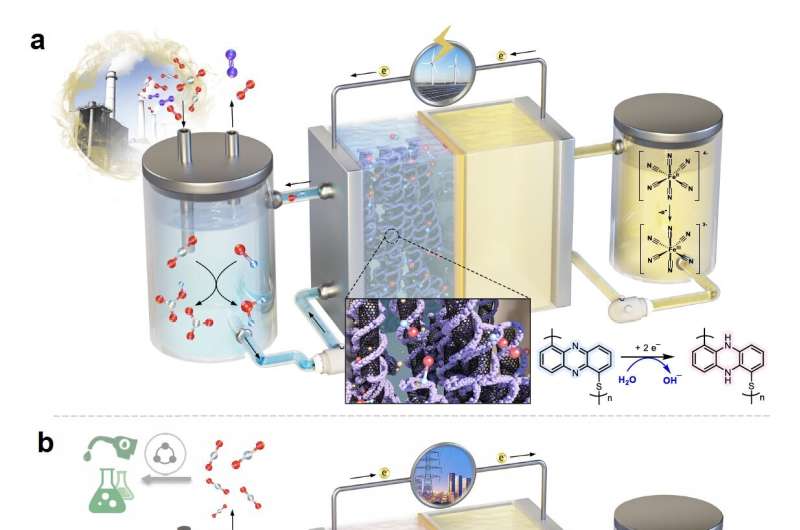
Over the past decades, energy engineers have introduced a wide range of systems and approaches aimed at mitigating climate change and preserving the environment on Earth. Given that global dependence on fossil fuels is likely to continue for the foreseeable future, many of these technologies focus on capturing carbon dioxide (CO2), one of the primary greenhouse gases contributing to climate change.
CO2 capture technologies could be deployed at industrial sites, power plants, and other facilities that are known to emit large amounts of CO2. One promising approach for the direct extraction of CO2 from the air is known as pH-swing electrochemical capture.
This method, which could be powered using clean energy solutions, is designed to absorb and release CO2 via a reversible reaction prompted by changes in acidity (pH). Despite their potential, pH-swing electrochemical capture solutions introduced so far have been found to deteriorate over time, which results in a reduced CO2 capture capacity because of the oxidation of redox-active molecules by O2.
Researchers at the University of Chinese Academy of Sciences, Harvard University and Westlake University have devised a new approach that could improve the reliability of pH-swing electrochemical capture technology.
This approach, outlined in a paper published in Nature Energy, relies on a hybrid flow cell system, an electrochemical device that could prevent undesirable chemical reactions between the molecules, enabling the extraction of CO2 from the air, even in the presence of O2.
“The build-up of atmospheric CO2 concentrations has been happening so rapidly, and the world’s efforts to mitigate greenhouse gas emissions have been proceeding so slowly that, by mid-century or so, humanity may find it necessary to pull CO2 out of the air,” Michael J. Aziz, co-senior author of the paper, told Tech Xplore.